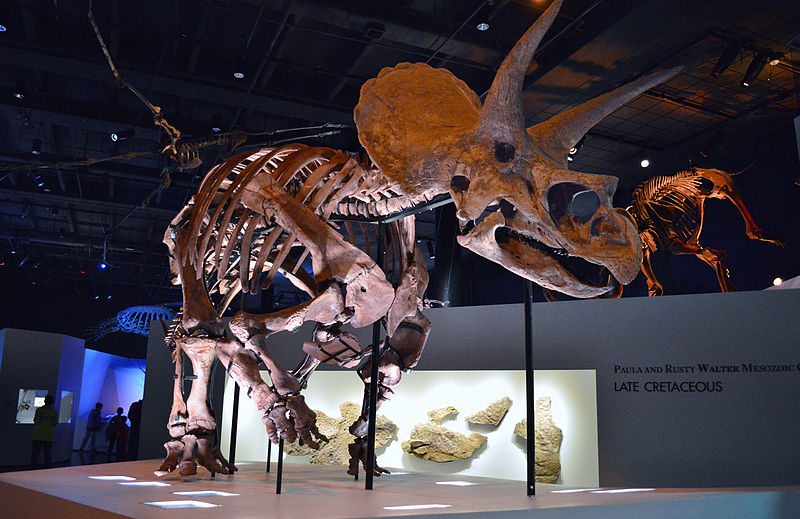
Triceratops Specimen at the Houston Museum of Natural Science
Get ready, Bone Diggers — today's dino is an absolute LEGEND. Meet Triceratops: one of the most recognisable, most jaw-dropping, most awesome dinosaurs that ever walked the Earth. Strap in, because this creature is going to blow your prehistoric socks off! 
 What on Earth IS a Triceratops?
Picture this: a creature the size of a large elephant, charging across a steaming prehistoric landscape with THREE enormous horns on its face and a magnificent bony frill fanning out around its head like a royal crown. That's a Triceratops — and it is every bit as spectacular as it sounds!
The name comes from Greek: tri (three), keras (horn), and ops (face). So its very name shouts the most important thing about it — the mighty three-horned-face! Those two long brow horns could grow to over one metre long — that's as tall as many of you reading this right now! Throw in a shorter nose horn and that stunning frill, and Triceratops might just have been the most dramatic-looking animal in all of Earth's history.
Here's how big this beast really was:
 Length: About 9 metres — roughly the size of a school bus
 Height: Around 3 metres at the shoulder
 Weight: Up to 12 tonnes — heavier than two large hippos combined
 Teeth: Around 800 tiny teeth, stacked in clever rows
 When it lived: 68 to 66 million years ago, in the Late Cretaceous period
 What Did It Eat?
Here's something that might surprise you — this big, armoured, horn-tastic beast was a complete and utter vegetarian! Triceratops was a herbivore, chomping its way through tough ferns, cycads, palms, and low-growing plants with a brilliant beak-like mouth (think a giant parrot beak, but on a creature that could squash a car).
It had hundreds of tiny teeth arranged in clever stacks called "dental batteries" — as the front teeth wore down, fresh new ones grew up from behind. Triceratops basically had a self-replacing set of chompers for life. Dentists everywhere are very jealous.
Because Triceratops was lower at the front than the back, scientists think it used its powerful neck and those impressive horns to push through thick, thorny bushes to reach the tastiest plants underneath. Basically, it was a living tank that went shopping for salad. 
 Who Was After It? Enter T. rex!
Triceratops didn't just have to worry about finding enough plants to eat — it shared its world with the most fearsome predator in history: Tyrannosaurus rex. Scientists have found Triceratops bones with T. rex bite marks on them AND T. rex bones with healed wounds that look suspiciously like they came from Triceratops horns.
So these two absolute legends of the dinosaur world actually went head-to-head — quite literally. And here's the amazing part: evidence suggests Triceratops didn't run. It turned and fought back. Scientists believe those horns and that thick frill acted as both weapons and shields in battle. What an absolute hero. 
 Who Found It? The Discovery Story!
The very first Triceratops bones discovered didn't get the reaction they deserved. In 1887, two horn cores were found near Denver, Colorado, USA — and the famous palaeontologist Othniel Charles Marsh thought they came from a giant prehistoric bison. Imagine finding the skull of one of the greatest dinosaurs ever and thinking "oh, it's just a big cow." 
Then in 1888, fossil hunter John Bell Hatcher found a much more complete skull in Wyoming, and Marsh quickly realised his mistake — this was something totally new. In 1889, Marsh officially named the creature Triceratops horridus. The word horridus means "rough" or "bristly" — referring to its skin texture, not its personality!
Today, over 50 Triceratops skulls and dozens of skeletons have been found, mostly across North America. It's one of the most commonly discovered large dinosaurs on the continent. Go, Triceratops! 
 Where Can You See One?
Want to stand face-to-face with a real Triceratops? Head to one of these incredible museums:
 Smithsonian National Museum of Natural History — Washington D.C., USA
- American Museum of Natural History — New York City, USA
 Royal Tyrrell Museum of Palaeontology — Drumheller, Alberta, Canada (one of the world's greatest dinosaur museums — absolutely worth the trip!)
 Natural History Museum — London, UK
 Museum für Naturkunde — Berlin, Germany
 Mind-Blowing Bonus Facts!
- That magnificent frill wasn't just armour — scientists now think it may have been brightly coloured, used to show off to friends or frighten enemies. A bit like a peacock, but prehistoric and enormous.

- Triceratops was one of the very last non-bird dinosaurs to ever exist. It was still roaming the Earth when the asteroid struck 66 million years ago. It was literally there at the end.
- The Triceratops skull could be nearly 3 metres long — almost half its entire body length. One of the largest heads of any land animal, ever.
- Young Triceratops likely had small, rubbery horn stubs that grew bigger over time, a bit like a deer's antlers — but infinitely cooler.
- The largest Triceratops skeleton ever found is nicknamed "Big John". Discovered in South Dakota in 2014, it sold at auction in 2021 for a staggering 6.6 million euros.

Keep Digging, Bone Diggers!
Triceratops proves that the prehistoric world was wilder, stranger, and more magnificent than we could ever imagine. And the best part? There are still so many fossils out there waiting to be discovered — maybe even by YOU one day!
Until next time — stay curious, keep digging, and never stop roaring! 
— The Bone Diggers' Club & DinoZone Team