ONE HUNDRED YEARS ON EARTH
A Celebration from DinoZone & the Bone Diggers Club
A Celebration from DinoZone & the Bone Diggers' Club
Today, 8 May 2026, Sir David Attenborough turns 100 years old. Let that land for a moment. One century. The same span of time that separates us from the Roaring Twenties, from biplanes and silent films — and this man has spent most of it pointing a camera at the natural world and daring the rest of us to pay attention.
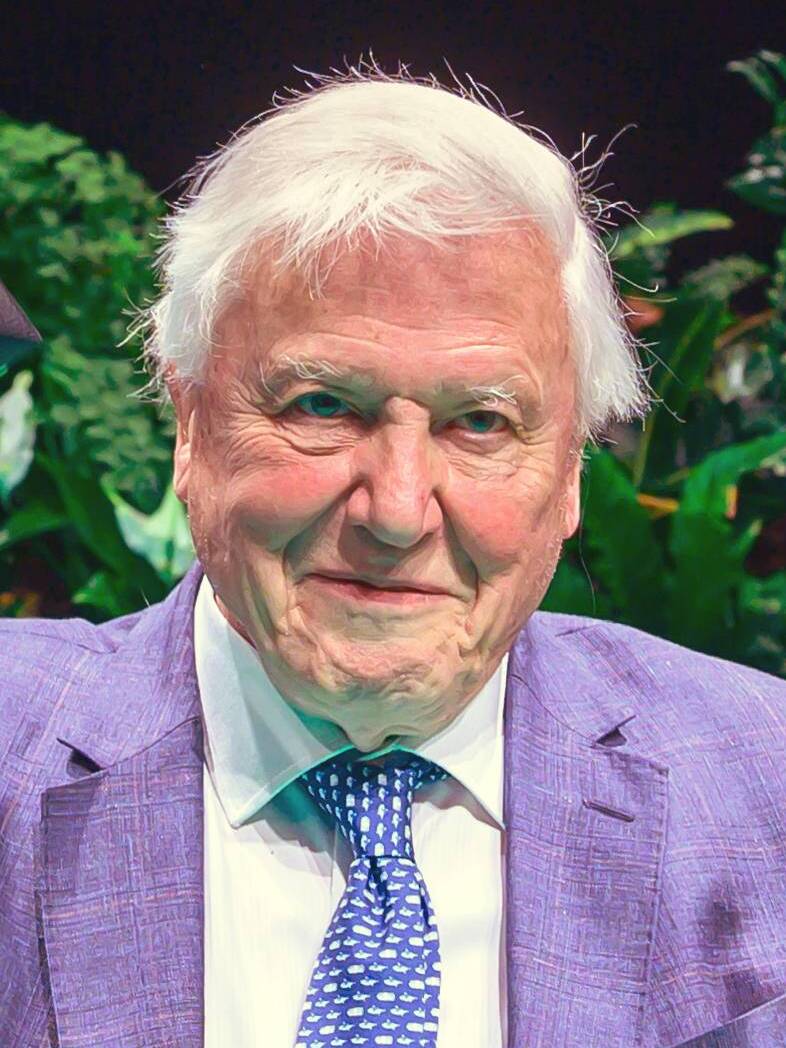
Sir David Attenborough (Source: Wikipedia 2026)
At DinoZone and the Bone Diggers’ Club, we don't need much of an excuse to talk about ancient life, deep time, and the rocks under our feet. But today we have the best excuse there is. So here's our honest, unvarnished tribute to the man who probably did more than anyone alive to make the prehistoric past feel urgent, vivid, and worth caring about.
It Started with a Hammer and a Rock
Before the BBC. Before Life on Earth. Before the knighthood, the 40-odd species named after him, and the honorary degrees stacked up like stratigraphic layers — there was a boy in Leicester, bashing lumps of limestone on the quest for coiled shells that hadn't seen the light of day in over 150 million years.
David Attenborough has described that moment himself: you strike a stone, it falls open, and there's a perfect ammonite. Nothing had seen it since the Jurassic. Until now. That feeling — the electric jolt of contact with deep time — is something every member of the Bone Diggers’ Club understands in their bones. It's the same feeling that sends us out on weekends with hats, and boots and too much sunscreen. For Attenborough, it never went away. It just scaled up.
He studied geology and zoology at Cambridge. The fossils never stopped interesting him. And throughout a broadcasting career of unmatched ambition and reach, the ancient Earth kept showing up — because he kept going back to it.
The Prehistoric Record
His CV speaks for itself.
In 2016, he presented Attenborough and the Giant Dinosaur, following the excavation of Patagotitan mayorum in Argentina — a titanosaur so vast that its heart alone measured two metres in circumference and its bones required seven individuals to fully account for. It remains one of the finest palaeontology documentaries ever made.
In 2018 came Attenborough and the Sea Dragon — a near-complete Temnodontosaurus skeleton from the Jurassic Coast, brought painstakingly out of the cliffs of Dorset. Then in 2024, Attenborough and the Giant Sea Monster, documenting the excavation of a pliosaur skull of almost absurd proportions from those same Dorset cliffs — a predator with a bite force that makes a great white shark look politely cautious.
These weren't vanity projects. They were serious science, communicated with clarity and genuine wonder, reaching audiences of millions who would otherwise never have heard of a pliosaur or cared about the difference between a sauropod and a titanosaur. That matters. Public understanding of palaeontology doesn't happen by accident — it happens when someone with reach and credibility makes the case, repeatedly, that this stuff is extraordinary.
Attenborough made that case for decades. He still makes it.
What He Actually Did
It's worth being precise about the scale of the achievement, because it's easy to let it blur into vague admiration.
Attenborough pioneered filming technologies — infrared, slow motion, underwater photography, time-lapse — that didn't just make better television, they produced footage that changed how scientists understood animal behaviour. His Life on Earth series set a standard for scientific scope and visual ambition that the entire genre of natural history broadcasting has been chasing ever since. A professor of science communication at University College London has argued that Attenborough made natural history as popular as football. That is not a small thing to have done.
He helped reframe the prehistoric past not as a cabinet of curiosities — dry bones under glass — but as a living narrative, one that connects directly to the world we're standing in. Every time a kid watches a titanosaur reconstruction and asks how do we know that?, somewhere upstream of that question is David Attenborough.
A Hundred Years
He grew up in the same house where his father ran the University of Leicester. His brother Richard — yes, that Richard Attenborough, the actor — grew up in the same rooms. The middle Attenborough boy chose rocks and animals and cameras.
A hundred years later, he has outlasted empires, technologies, broadcasters, and most of the species he once went looking for. He has more than 40 plants and animals named after him. He was knighted in 1985. He has honorary degrees from more British universities than any other person on record.
None of that is why we're celebrating him today. We're celebrating him because he picked up a rock as a child, found something ancient inside it, and spent the next nine decades insisting that the story of life on Earth is the most compelling story there is.
At the DinoZone and the Bone Diggers’ Club, we happen to agree.
Happy 100th, Sir David. The bones are still out there. Thanks for showing us how to look.
— The DinoZone Team & the Bone Diggers Club